We surveyed more than 34,000 small and midsize business owners across the US, Canada, the UK, and Australia and combined their responses with anonymized data from more than 5.3 million QuickBooks businesses. This is the most comprehensive look at how small and midsize businesses are adopting AI, and what it's doing to their revenue, productivity, and growth. Get the full findings below. Just click to read.
Table of contents
Table of contents
Artificial intelligence (AI) has moved from the sidelines of business operations into the work clients do every day: marketing, customer service, admin, and planning.
The 2026 Intuit QuickBooks AI Impact Report puts numbers behind that shift. In the US, more than 3 in 4 small to midsize businesses now report using AI regularly. Among those using AI, productivity is the clearest win, and the upside extends to revenue, workforce growth, and costs. Across those areas, businesses using AI are more likely to report gains than setbacks. At the same time, trust remains the biggest barrier to deeper adoption.
That combination matters for accountants. AI is already touching the work that shapes their clients' productivity, growth, costs, records, reporting, and business decisions. But many businesses still have real concerns about privacy, accuracy, accountability, and when human review is needed.
As a result, the client AI conversation has evolved. The question is no longer whether clients are using these tools. The sharper questions now are where, how, with what risks, and where human judgment still matters most.
Research methodology: 5.3 million businesses and 34,000+ survey responses from 18 months of tracking
The 2026 AI Impact Report tracks AI adoption, spend, and business impact using two sources:
1. Anonymized payment records from more than 5.3 million small to midsize businesses using Intuit products across the US, Canada, and the UK.
2. More than 34,000 survey responses from business owners and operators across the US, Canada, the UK, and Australia, collected between July 2024 and January 2026.
The methodology was developed by an international team of economists led by Ufuk Akcigit of the University of Chicago, in collaboration with Intuit.
The combination of data sources gives the report a broader view than surveys could alone. Survey responses show how businesses say they are using AI and what impact they report. Payment records show which businesses have moved from interest to investment.
That distinction matters throughout the report. Regular AI use includes a wide range of activity, from free tools and embedded features to dedicated paid subscriptions. Payment data captures a narrower signal: businesses that have put budget behind dedicated AI tools.
1. Businesses using AI are more likely to credit it with gains than losses
In a difficult year for small businesses, those using AI were more likely to say AI helped rather than hurt. That context matters. Findings from the 2026 Intuit QuickBooks Small Business Index Annual Report reveal US small business employment decreased by 49,100 jobs in 2025 compared with 2024, and average real annual revenue declined by $21,270 per business, or 3.46%.
Against that backdrop, AI’s impact stands out. Across productivity, revenue, workday length, hiring, and costs, US businesses using AI consistently report more positive effects than negative ones.
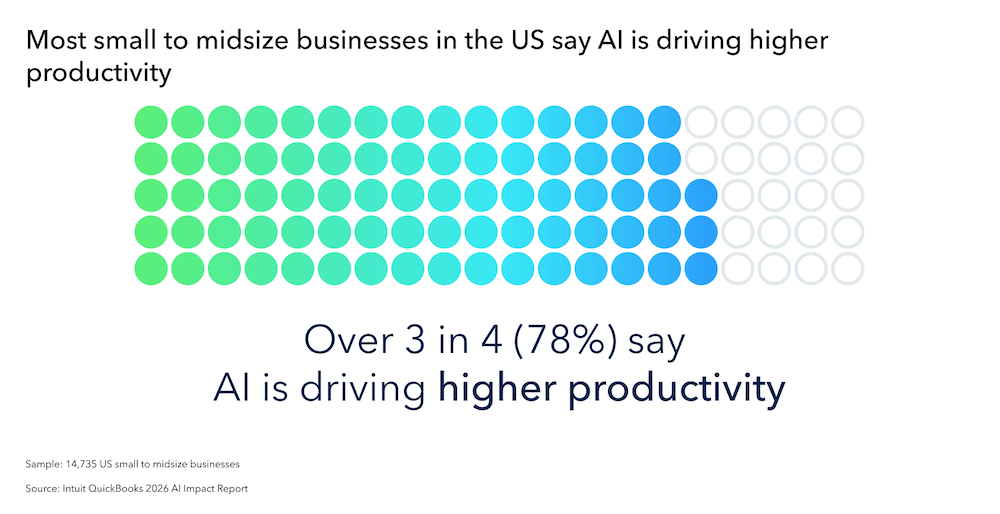
Productivity: the strongest signal—January 2026 survey data shows 78% of businesses using AI say it’s improved their productivity, up from 46% in July 2024.
The share calling AI “very helpful” for productivity doubled from 19% to 38% over the same period.
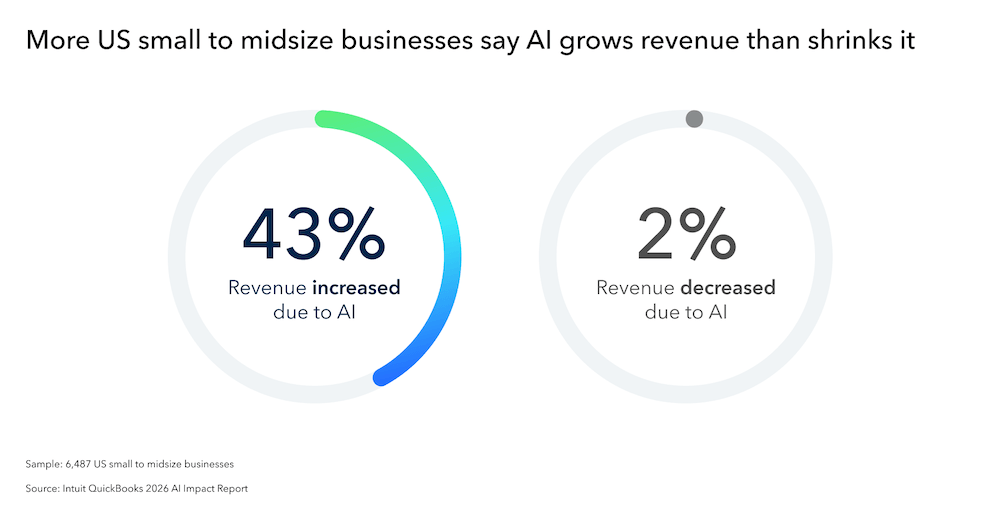
Revenue: More often up than down—Two in 5 (43%) businesses using AI credit it with revenue gains. Only 2% report revenue declines tied to AI.
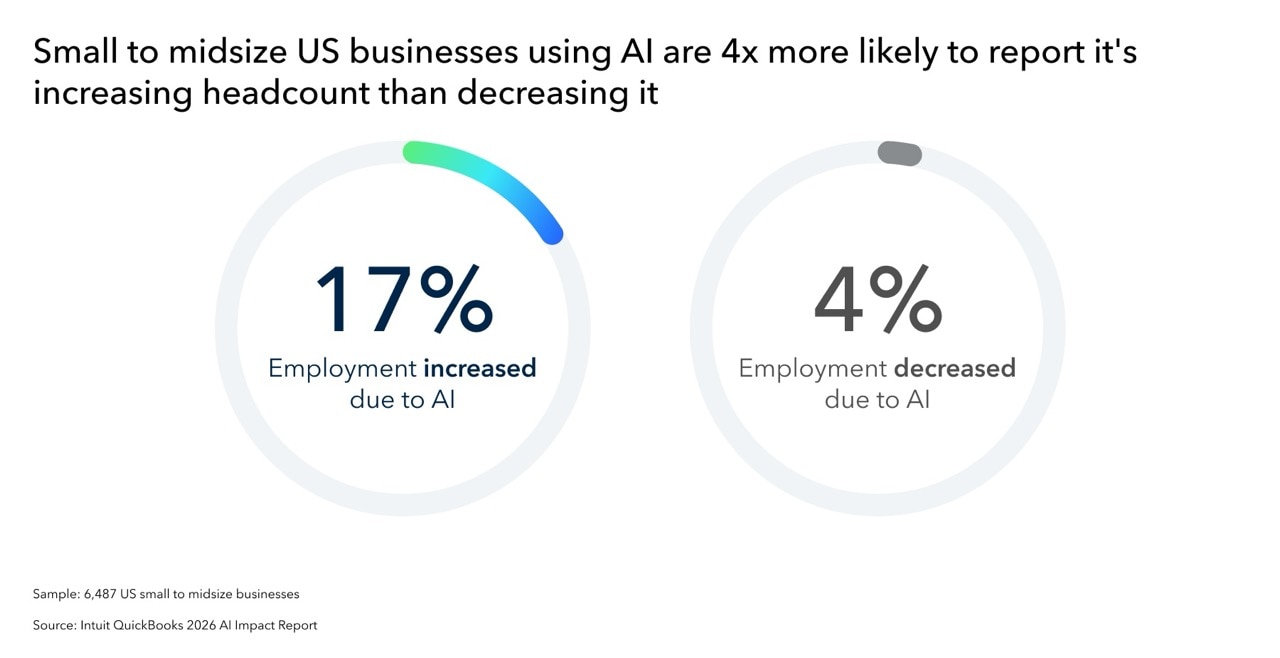
Hiring: Growth outpaces cuts—Businesses are 4x more likely to report AI has increased headcount than decreased it (17% vs. 4%).
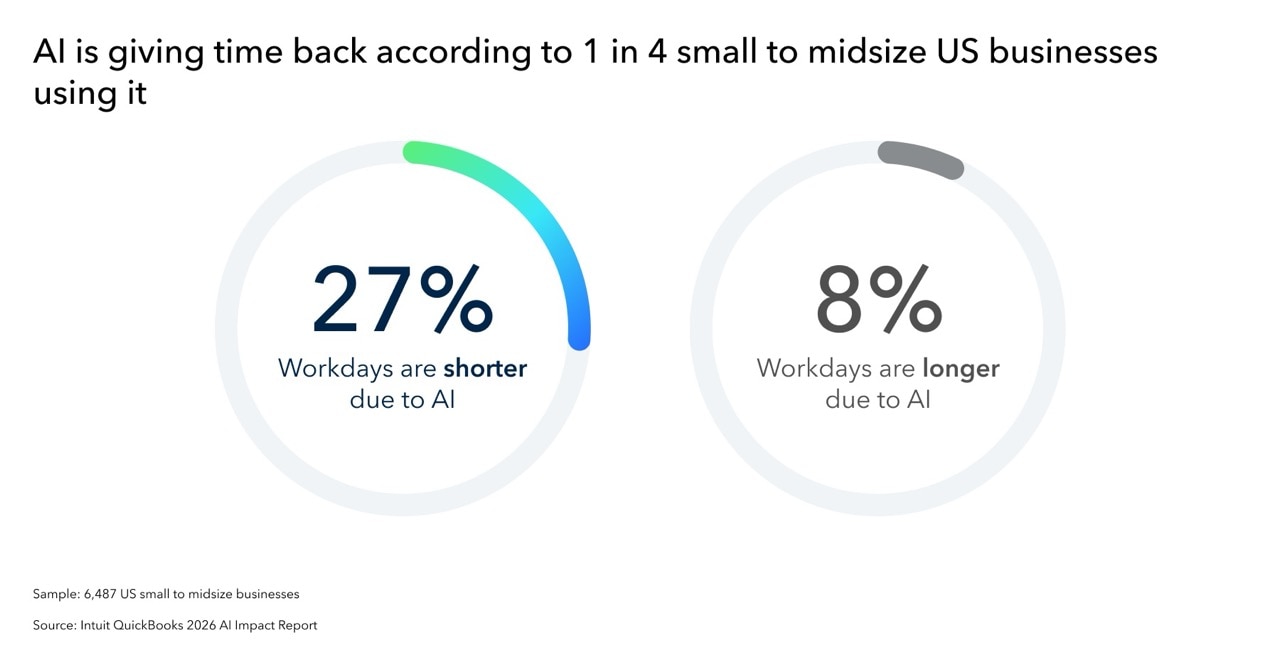
Workday length: Some are getting time back—One in 4 businesses using AI (27%) report it has shortened their workday, compared with 8% who say it has made the day longer.
Costs: Savings edge out spending—They’re also 1.7x more likely to report AI has reduced costs (29%) vs. increased them (17%).
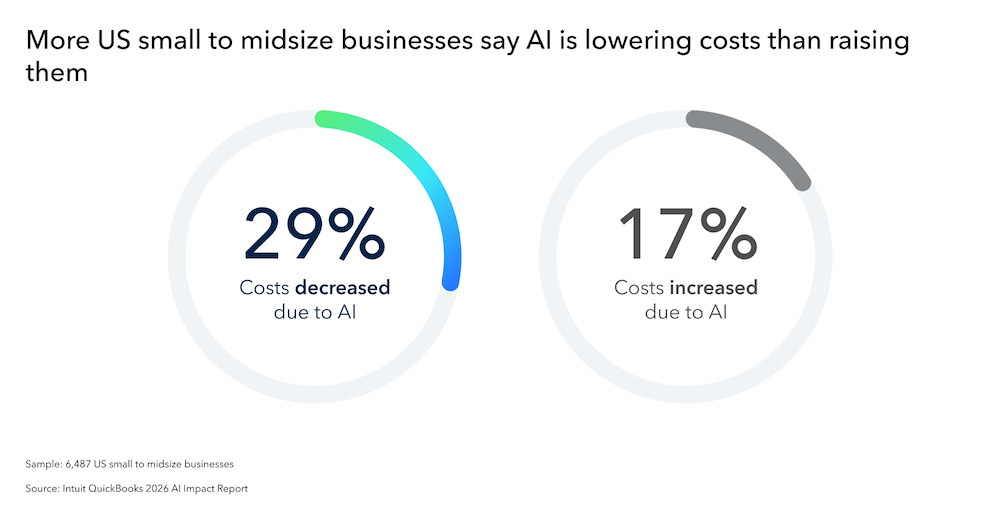
Taken together, businesses using AI are connecting it to the outcomes accountants already track and advise on.
Why this matters for accountants
These results are business-performance signals.
If AI is affecting productivity, revenue, labor needs, workday length, or cost structure, those changes may shape forecasting, margins, planning, hiring, capacity, and the broader advisory conversation well before they show up in year-end results.
For accountants, AI belongs in the performance conversation now.
2. AI use is broad, but paid commitment is narrower—and sticky
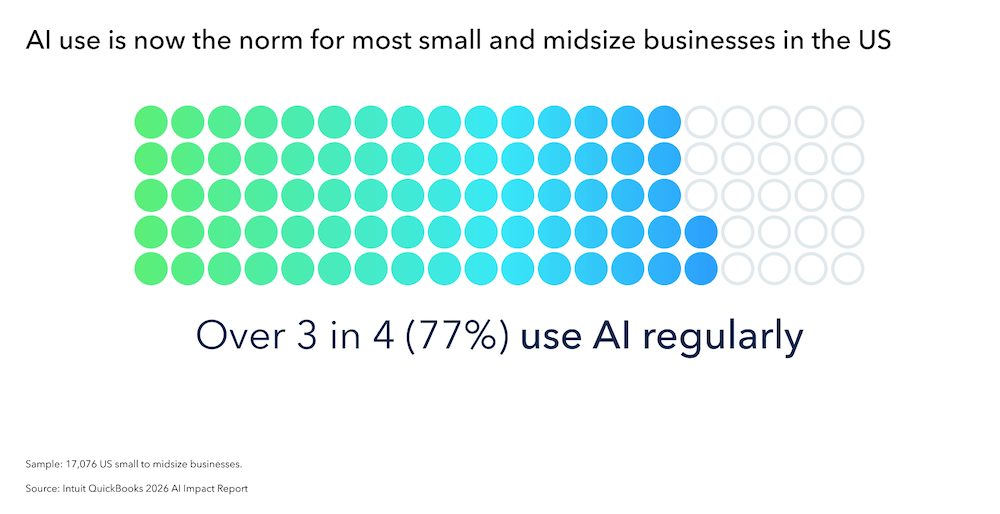
AI use has spread far beyond early adopters. In the US, more than 3 in 4 (77%) small to midsize businesses now report using AI regularly, whether through free apps, embedded AI features, or paid subscriptions.
But payment data points to a smaller committed core. In the observed businesses, about 1 in 10 paid for dedicated AI tools between 2021 and 2025.
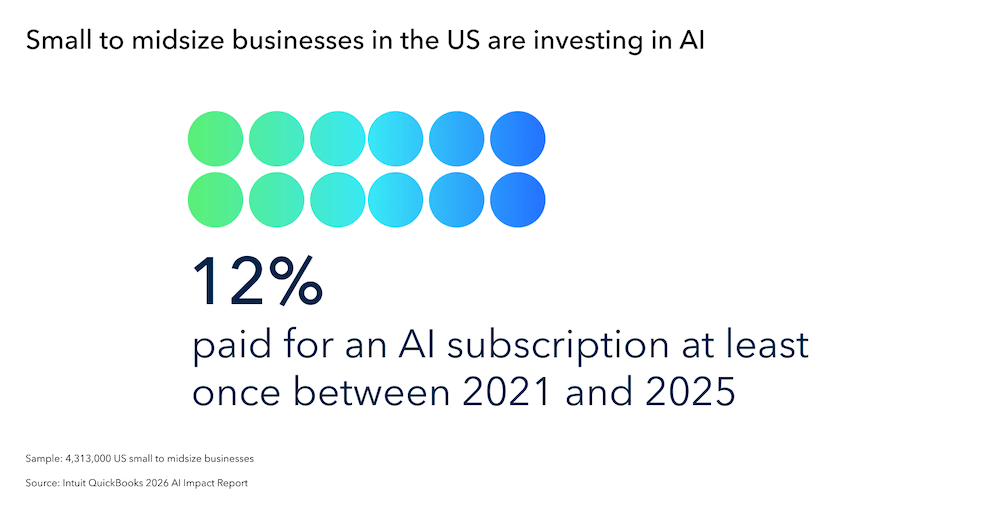
That gap matters. Many businesses are still experimenting with free tools or AI features built into software they already use. A smaller group has crossed into paid adoption, where AI becomes less of a tool to try and more of an operating investment.
But once businesses cross that line, most stay invested. Among US businesses that paid for dedicated AI tools in 2024, 86% were still paying in 2025.
Why this matters for accountants
Not all AI use carries the same implications.
A client occasionally using a free AI tool to draft marketing copy faces a different set of questions than a client paying for AI tools embedded in customer service, forecasting, operations, or financial workflows.
For some clients, AI is also shifting from trial expense to durable operating cost. A subscription may look small in isolation. The workflow change behind it may not be.
Accountants can help clients understand whether AI spending is simply another tool cost or a signal of broader changes in process, capacity, staffing, risk, and decision-making.
3. Trust concerns are holding clients back from more AI
If AI use is spreading quickly, why are some businesses still holding back?
The report points to trust.
Across the US, Canada, the UK, and Australia, the top barriers are consistent:
- Privacy and security concerns.
- Lack of knowledge about AI’s capabilities.
- Concerns about accuracy, bias, and errors.
In the US, 36% of businesses cite privacy and security concerns as a barrier. Lack of knowledge about AI’s capabilities follows at 28%, and concerns about accuracy, bias, or errors come in at 26%.
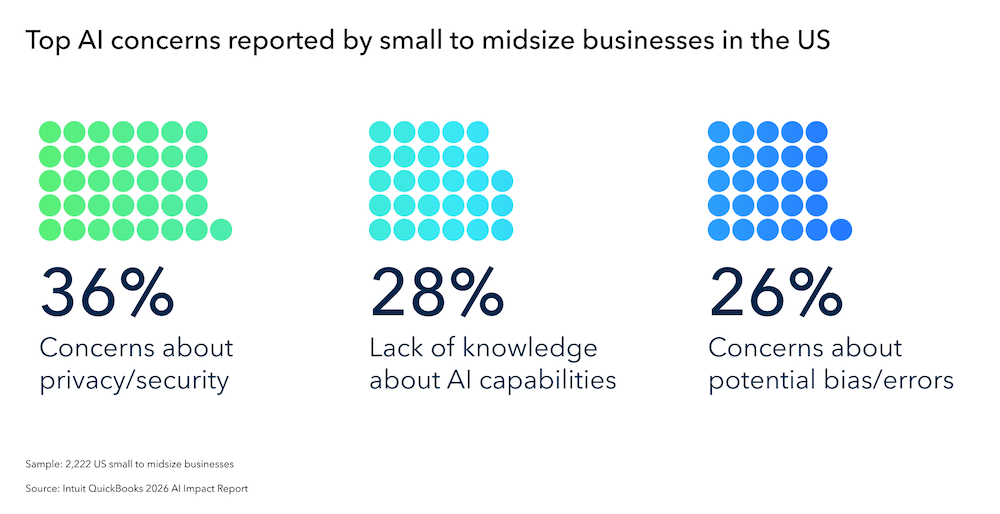
Cost ranks below those concerns.
This signals the real adoption gap comes down to confidence. Businesses are asking more than, “Can we afford this?” They are asking, “Can we trust this?”
Why this matters for accountants
The profession is built on exactly this kind of work: helping clients think through risk, reliability, process, controls, and accountability.
Clients may need help asking practical questions:
- What data is being entered into AI tools?
- Where are AI outputs being used?
- Who reviews the work before it affects records, reports, or decisions?
Many businesses holding back on AI are not rejecting it outright. They are waiting until they understand how to use it responsibly. Accountants are well positioned to help them get there.
4. The businesses going deepest on AI have a clear profile
From the report’s sample, businesses paying to use AI in the US share a recognizable profile.
Business characteristics:
- Newer and growth-focused.
- Targeting fast growth over stability (this gap runs to more than 20 percentage points).
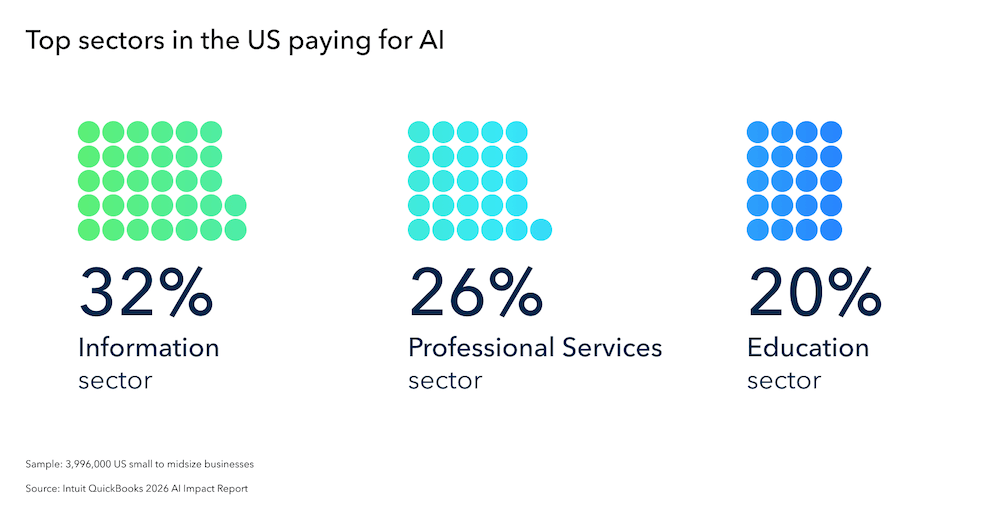
- Most likely to operate in information, professional services, or education: sectors that run largely on writing, analysis, and client communication, where AI fits directly into existing workflows.
Leadership characteristics:
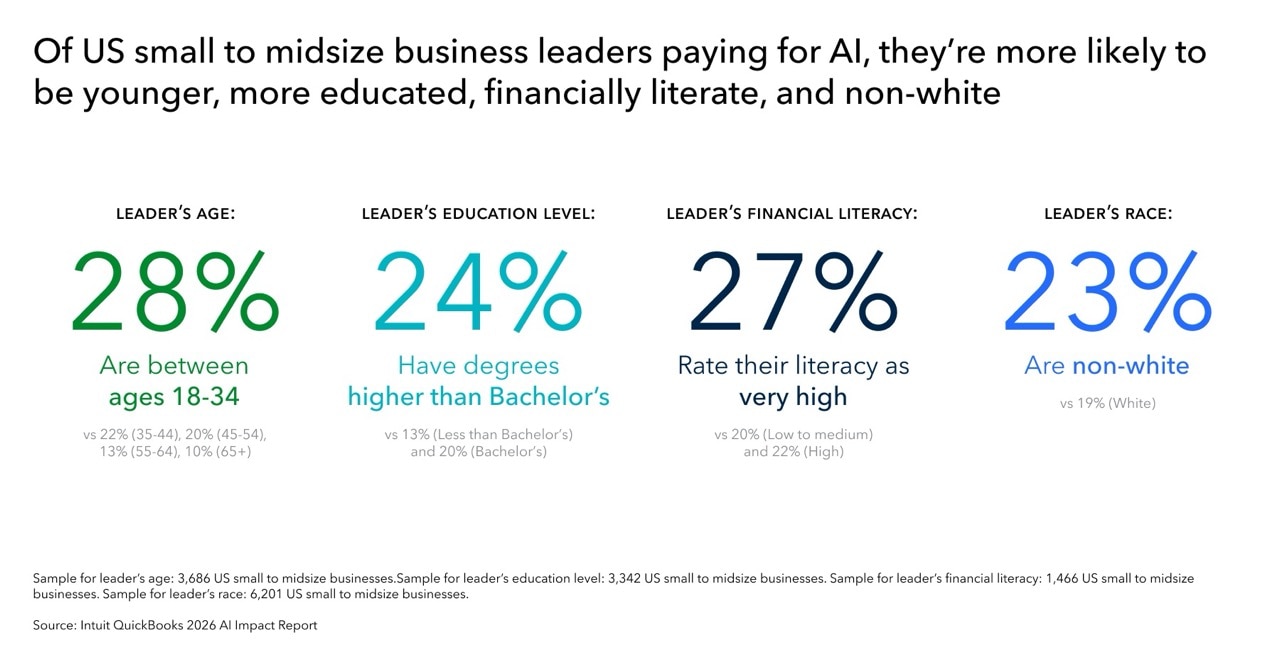
- Younger leaders: 28% of businesses under leaders aged 18–34 paid for AI, versus 13% of those fronted by older leaders (aged 55–64)
- Higher education levels are an independent predictor of paid AI adoption
Why this matters for accountants
This helps clarify where AI-related questions may surface first. A fast-growing professional services client may already be using AI across marketing, proposals, analysis, client communication, and operations. A newer business may be building AI into its workflows from the start. A more established client may be moving more slowly because of legacy systems, data concerns, process complexity, or uncertainty about where AI fits.
Both clients may need guidance, but the conversation will look different. Knowing where AI adoption is advancing fastest can help accountants shape stronger advisory conversations by industry, growth stage, and client profile.
5. AI is becoming part of everyday workflows
Businesses are not using AI evenly across every task. They are most likely to use it in practical, day-to-day work where there are clear inputs, visible outputs, and room for human review.
Top AI tasks: Marketing, customer service, and bookkeeping
In the US, data averaged across all waves shows AI is showing up most in marketing, customer service, and admin.
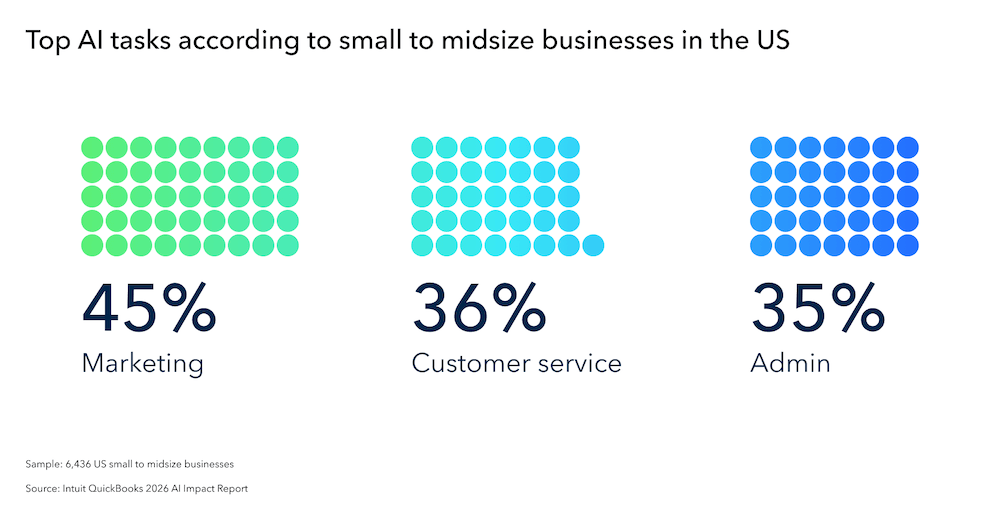
These fit the pattern: outputs are visible, feedback is fast, and mistakes can usually be caught and corrected before they create bigger problems.
A more recent finding from January 2026 adds complexity. Bookkeeping has entered the top three tasks where US businesses report using AI. That does not mean businesses are moving to AI-only bookkeeping. Survey data captures a wide spectrum of use, from standalone tools to AI features already embedded in the software businesses use every day. The signal is that AI is increasingly becoming part of the bookkeeping workflow, not replacing it.
Bottom AI tasks: Employee management, product management, and legal
At the other end, businesses are more cautious where decisions are harder to reverse and accountability is harder to hand off: employee management, product management, and legal.
Legal is the clearest example. Businesses are drawing a line: The higher the stakes, the more cautious they are.
Why this matters for accountants
The pattern businesses are following, AI where outputs are easy to review and caution where stakes are high, is the same logic accountants apply every day. The difference is that AI is now inside the workflows, including bookkeeping-adjacent ones, where errors do not stay contained.
When AI touches financial records, the questions shift to review, documentation, and accountability. Who checks the output? Who catches the error? Is there a supportable trail behind the final numbers? Those are live questions wherever AI touches financial workflows.
The accountants best positioned to help will be the ones who understand where AI can accelerate the work, where it still falls short, and what review processes are needed to make the output dependable. As AI takes on more routine work, that guidance shifts upward: strategy, growth, risk, and long-term planning.
The bottom line
AI is already part of how many clients work. The 2026 Intuit QuickBooks AI Impact Report makes that clear.
Businesses using AI are more likely to report more gains than losses in productivity, revenue, headcount, and costs. And the biggest brakes on broader adoption cluster around confidence: in the tools, the outputs, and the oversight behind it. That gap is not closing on its own.
This is where accountants matter. Not as AI experts, but as the professionals clients already trust to help them think through risk, reliability, and accountability. When AI touches bookkeeping, reporting, or records, the questions do not go away. They get sharper: what is being used, what is being reviewed, and who signs off.
The practical starting point is straightforward: ask clients where AI is showing up in their work, what it’s touching, and who is reviewing the output before it affects records or decisions. The accountants that build those guardrails will be better positioned as AI moves deeper into everyday operations, and as more of the value shifts from producing the numbers to advising on what they mean.
Grow your business with the QuickBooks ecosystem
Free Calculators

Advisory
Forecast your firm’s CAS revenue—instantly

Artificial Intelligence
Reveal the ROI of AI in your firm
eBooks

Advisory
Grow Your Firm with Client Advisory Services: eBook

Advisory
Grow Your Firm with Value-Based Pricing for Client Advisory Services: eBook

Advisory
Value-Based Pricing Questions to Ask Your Clients: eBook

Artificial Intelligence
AI in accounting: How AI is rewriting the accounting playbook
More on CAS

QuickBooks ProAdvisor
ProAdvisor In the Know: Client Accounting Services Learning Pathway

QuickBooks ProAdvisor
Client Advisory Services Foundations: The next evolution of accounting education
Podcast
On the Books: Growth, change, and the future of CAS—A conversation with Kane Polakoff

Artificial Intelligence
AI fraud detection for client advisory firms

Advisory