A general ledger that closes itself
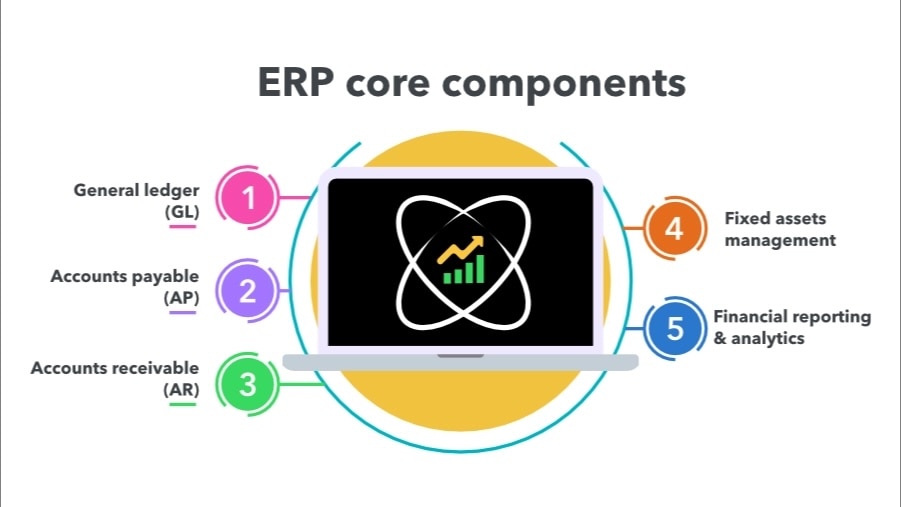
In a modern ERP, the general ledger stays current without anyone having to actively maintain it. AP, AR, and inventory post directly, so the trial balance reflects reality at any given moment. For clients spending days on month-end close, that shift alone is significant.
Dimensional tagging is where modern ERPs pull ahead of standard accounting software. Rather than maintaining a bloated chart of accounts with endless sub-accounts, transactions get tagged by dimension: department, project, customer, location. The chart stays clean, and reporting becomes genuinely flexible, pulling P&L by project or customer profitability in minutes.
Multi-entity and multi-currency support follows the same logic. Businesses managing subsidiaries or international operations get consolidated reporting without manual reconciliation across entities. For growing mid-market clients, this is often the capability that makes their existing tools feel inadequate—and the clearest signal they've outgrown standard accounting software.
Accounts payable that runs in the background
Three-way matching of invoices, purchase orders, and receipts happens automatically. Discrepancies route to the right approver without anyone managing the process. Duplicate invoices get flagged, recurring expenses automate, and vendor communication moves through a portal rather than email chains. The net effect is that AP stops being a time sink and starts being a controlled, auditable process.
Accounts receivable tied to cash flow strategy
When an order ships, the ERP generates the invoice, sends it, and updates cash flow projections simultaneously. More advanced systems apply machine learning to predict payment timelines based on customer history, so clients can manage working capital proactively rather than reacting to shortfalls. That's a meaningful shift for businesses where cash flow timing drives operational decisions.
Fixed assets managed, not just tracked
Depreciation calculates automatically against tax or GAAP requirements, which removes days from month-end close for capital-intensive businesses. Beyond that, modern fixed asset modules track maintenance schedules, warranty periods, and insurance coverage—turning asset management from a compliance exercise into an operational one.
Reporting that serves the whole business
Real-time dashboards replace the wait for spreadsheet roll-ups. Department heads access their own views without fielding requests through finance, which frees the accounting team for higher-value work. Dimensional reporting means granular analysis by region, product line, project is available on demand rather than built from scratch each time.
AI and agent orchestration
AI is becoming a core part of what modern ERPs deliver, not a separate layer on top. Anomaly detection, predictive cash flow modeling, automated reconciliation, and natural language querying are increasingly standard features. Layered agent orchestration takes it further: agents that monitor thresholds, flag risks, and trigger workflows without human intervention. For advisory firms, this shifts the conversation with clients from "here's what happened" to "here's what's about to happen and what we should do about it."
Benefits of ERP Accounting
ERP accounting transforms how businesses operate by eliminating the manual processes and disconnected systems that typically constrain growth. The result is a single source of truth across every business function—one that prevents fragmented data, keeps teams looking forward rather than backward, and gives accountants and advisory firms more bandwidth to serve as strategic partners to clients.
A few of the core benefits include:
- Streamlined financial processes: ERP automation—including AI-powered matching and reconciliation—handles invoice processing, report generation, and error resolution end-to-end, slashing the hours once spent on manual data entry and error chasing.
- Eliminated double data entry: Operational transactions automatically become accounting entries, so financial data reflects what's actually happening in the business—not a delayed, manually assembled version of it.
- Real-time financial visibility: Live dashboards surface cash, sales, and cost metrics as they happen, so leaders can adjust prices, staffing, or spend in the moment, not days later.
- Built-in compliance and controls: Audit trails, approval workflows, role-based security, and standardized posting rules run in the background, keeping records clean and regulators satisfied.
- Strategic decision-making support: Because operational and financial data share one source, ERP reporting pinpoints margin drivers, forecasts cash needs, and highlights best-performing products or locations. With AI and layers of agent orchestration, that capability goes further, surfacing insights and triggering actions that traditional systems can't deliver without weeks of manual analysis.
Choosing the right ERP accounting software
Not every ERP system works for every business. The key is helping clients evaluate their current pain points and future goals, then finding solutions that support growth. Here are a few of the main factors to consider when comparing options:
Scalability
A common mistake is choosing an ERP system that is either too complex for a business's current needs or too rigid to adapt to growth. Many traditional ERP systems are feature-heavy and can overwhelm smaller businesses with unnecessary complexity.
When advising clients, encourage them to choose a platform that strikes the right balance between robust capabilities and manageability. Cloud-based systems tend to be a good option because they can scale well with a business, offer flexible pricing, and maintain simplicity in day-to-day operations.
AI-native ERPs take this a step further, turning systems of record into systems of intelligence that surface insights, automate routine work, and help teams focus on the next best action.
Intuit Enterprise Suite, for example, strikes that balance well. Multi-entity management, advanced accounting, and automated intercompany operations give controllers a single, accurate view of the business so they can close faster and with more confidence.
Hundreds of entities are handled from one platform, so scaling through acquisition or expansion doesn't trigger a migration or a costly customization project. And as the business grows, the connected ecosystem of 850+ integrations across 20+ industries means the platform adapts to how operations actually evolve rather than forcing a generic mold. CFOs get what they need from a modern system: real-time insights that support forward-looking strategy rather than historic reporting.
Industry- or company-specific functionality
Generic ERP systems can work, but they usually need multiple systems and processes to handle unique company characteristics and needs. If a client runs a manufacturing operation, construction company, or professional services firm, industry-specific workflows such as job costing or bill-of-materials tracking can save significant time and avoid costly disruptions right out of the box.
For businesses operating multiple entities—for example, a financial services firm managing different business units—intercompany journal entries are a main ERP requirement. The ability to easily record transactions between entities and maintain accurate consolidated reporting, a notable feature of Intuit Enterprise Suite, can save hours of manual reconciliation work each month.
Integration requirements
Many businesses already use specialized tools for CRM, time tracking, or payroll that work well for them. Rather than forcing them to abandon systems that aren't broken, look for an ERP that comes with a Customer Hub and CRM tools, such as Intuit Enterprise Suite, or ones with strong integration capabilities. The goal is centralization without unnecessary disruption.
Large and growing integration ecosystems also protect the investment for the long term. As business needs change and new tools emerge, well-connected ERP systems can adapt without requiring complete overhauls.
Cloud and AI readiness
Cloud and AI aren't future considerations at this point—they're current selection criteria. The global cloud ERP market is projected to grow to $233.38 billion by 2032, according to data from SkyQuest; similarly, AI in ERP is projected to grow to $46.5 billion by 2033, according to Market.us.
When advising clients on system selection, these numbers matter less than what they signal: businesses that choose on-premise or AI-light systems today are likely to face a costly migration or capability gap within a few years. Cloud-based, AI-native platforms are where the market is going, and letting clients get locked into something that isn't scalable is a costly mistake.