News

2026 Accountant Technology Survey: AI, fragmentation, and the future of the profession

About the research

We surveyed 725 US accounting and bookkeeping professionals to quantify the day-to-day reality of the profession in 2026: app and software sprawl, time lost to rework, how deeply AI is embedded in workflows, and what’s constraining advisory capacity, trust, and talent. This is a comprehensive snapshot of what’s changing in the industry right now and what will separate the accountants who lead the next era from the ones who get stuck in the grind.
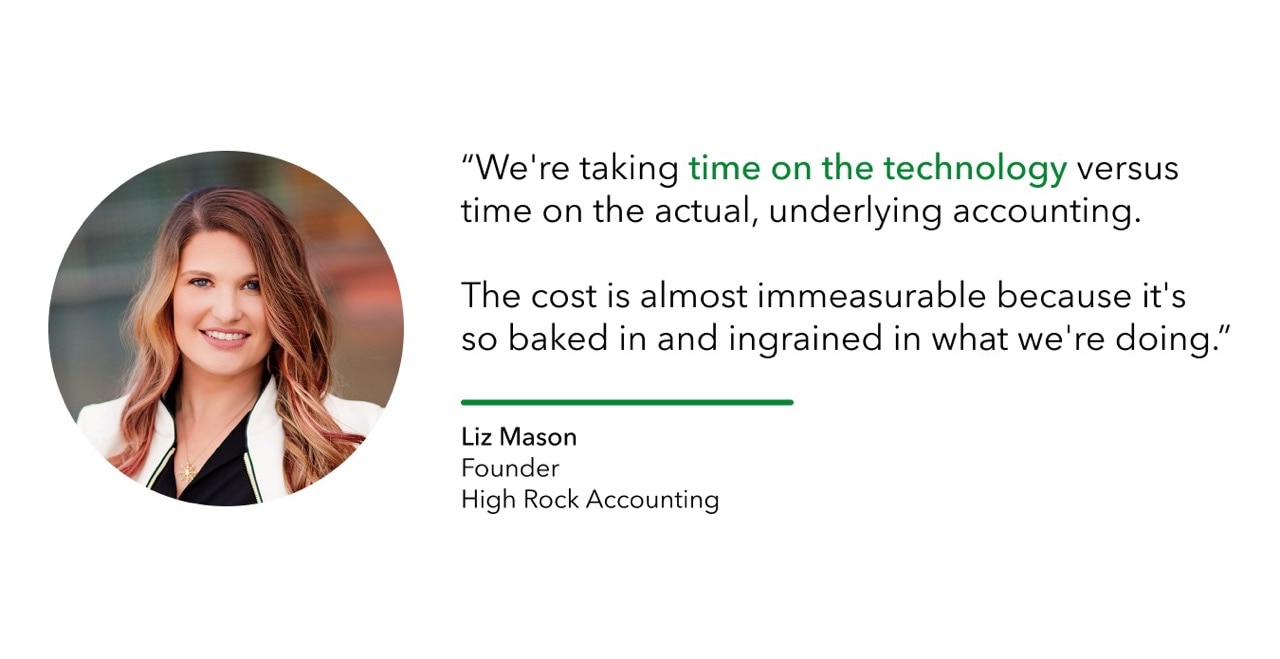
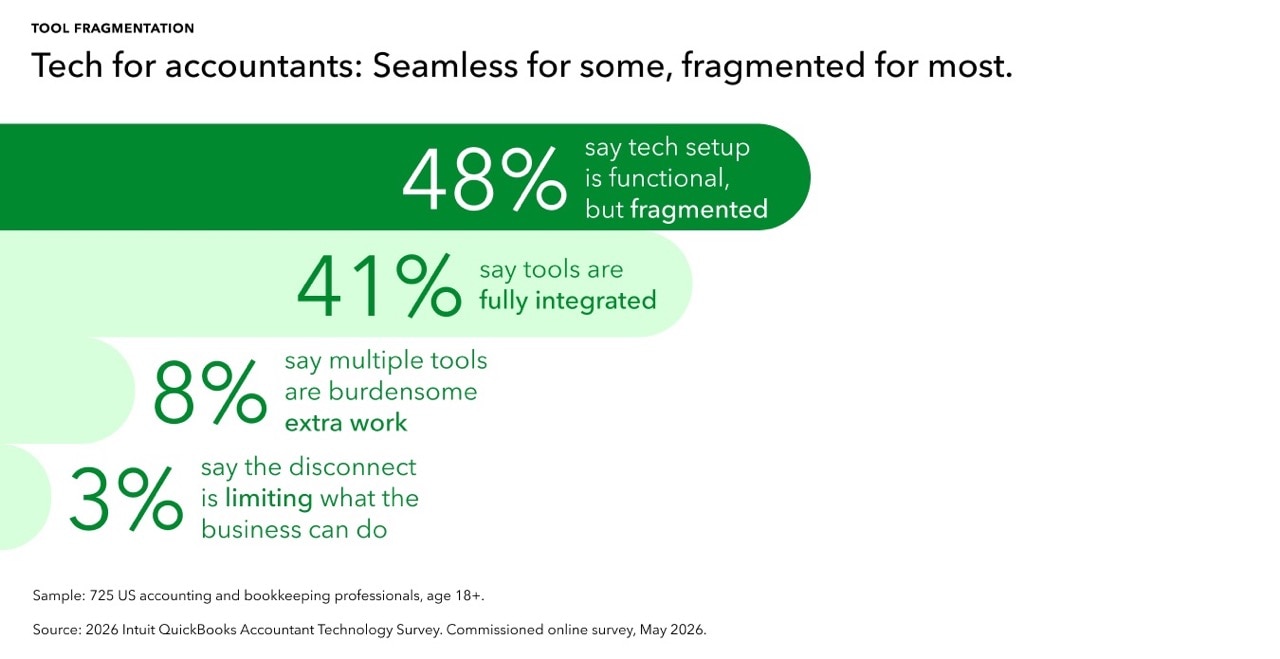
Table of contents

Table of contents

The complexity tax.

Tech stacks are crowded. The work still gets stuck in the seams.

Accounting firms keep investing in technology, but staff still burn real hours every week moving data, re-entering information, and reconciling across systems. This year’s findings show how that friction turns into lost time and constrained capacity.

2026 Accountant Technology Survey

How fragmented are accounting firm tech stacks in 2026?

  • Tool sprawl: The average firm uses 10 apps or software programs to manage operations and clients, and 1 in 3 respondents say their firm uses 11+.
  • Integration is uneven: 41% say their tools are fully integrated. 48% say their setup works, but remains fragmented.
  • Time lost is material: Accountants report losing approximately 5 hours per week moving, re-entering, or reconciling information across tools. That’s more than half a workday before client work even starts.
  • Spend is rising: 92% invested in tech in the last 12 months, averaging approximately $21,000 (up from $19,000 reported last year). 91% plan to invest again next year, expecting to spend $22,000 on average.
  • Two client realities at once: Respondents say 53% of their clients are tech-advanced or proficient and 47% are tech-limited or challenged. Workflows have to support both ends of the spectrum at the same time.
2026 Accountant Technology Survey

AI adoption is table stakes in 2026. Depth is where the divide is emerging. 

AI is already part of accounting work. The gap is how deeply firms have built it in.

AI is already part of accounting workflows, and the data shows it’s delivering. Adoption held steady from 2025, with 88% using AI for client services and 86% for firm operations. With adoption already high, the 2026 story is less about whether accountants are using AI and more about how deeply they have it built into their work. That difference is visible in how confidently they operate, how much capacity they unlock, and how quickly they can move.

2026 Accountant Technology Survey

How deeply is AI embedded in accounting workflows in 2026?

  • AI use is broad: 88% used AI for at least one client service in the last 12 months, holding steady from 2025 (top uses: data entry and processing 54%, financial forecasting 51%, real-time insights 49%). 86% used AI for at least one firm operation, also consistent with 2025 (top uses: invoicing and payments 53%, client communication 50%, managing client portfolios 44%).
  • Depth is the differentiator: 30% say AI is embedded as the default in day-to-day work. The largest group (54%) uses AI situationally.
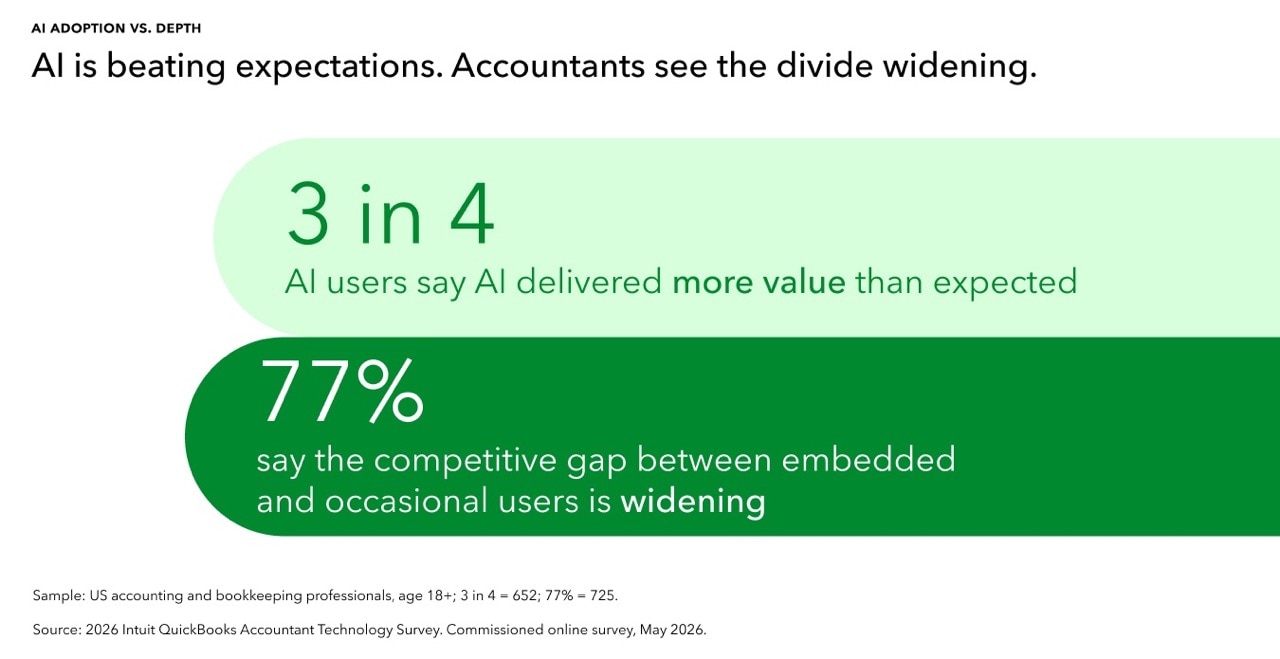
  • The payoff is showing up: Among AI users, 3 in 4 report AI delivered more value than expected.
  • Expected wins are practical: Top expected AI benefits in the next 12 months are more sustainable workloads (56%), greater confidence in the work delivered (56%), and more consistent output quality (54%).
  • For client deliverables, humans stay in charge: When asked what role AI should ideally play in client work and deliverables, 40% want AI as a support tool and 34% want AI to draft, with a human reviewing and signing off. Only 6% want AI to execute autonomously.
  • A widening competitive divide: 77% agree the gap is widening between firms where AI is embedded in daily workflows and firms that use it only occasionally.

AI is clearing the path to higher-impact work.

Getting to higher-impact work is an operational problem, not an ambition one.

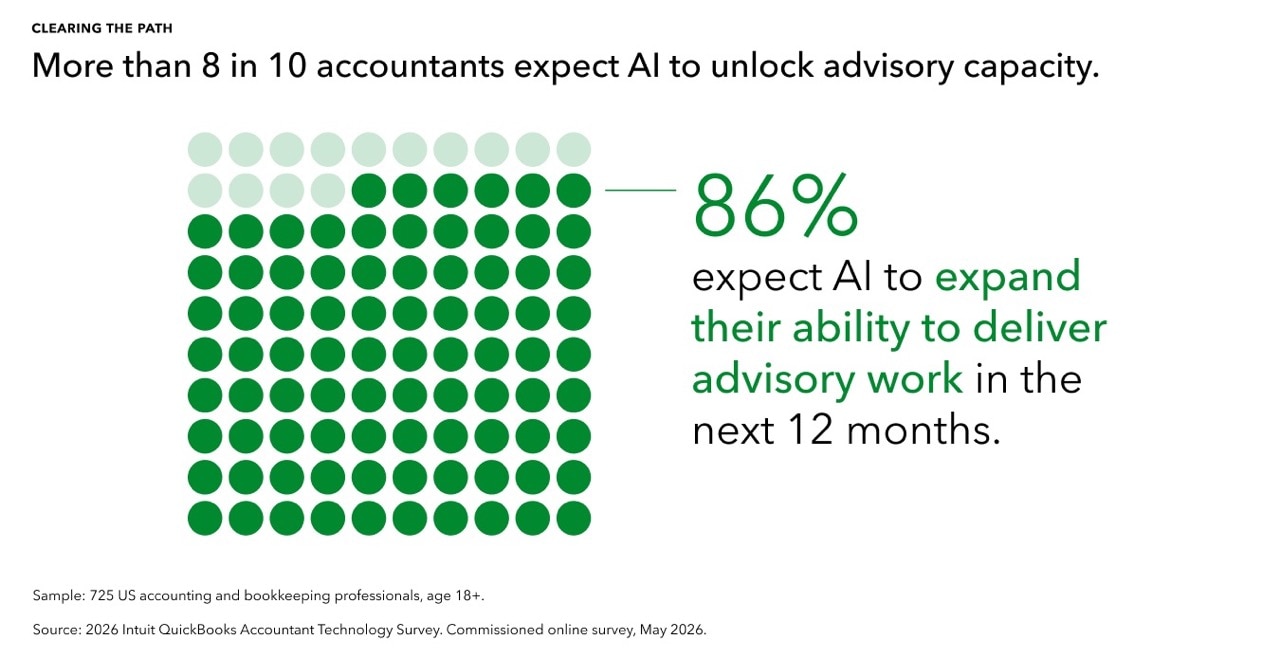
Advisory growth is running into a wall: time gets eaten by fixing books, chasing inputs, and keeping work moving. More than 8 in 10 accountants expect AI to clear that bottleneck. At the same time, outsourcing is rising as a second capacity engine, giving firms two ways to move routine work off their plates so human time can go where clients still pay a premium: judgment, clarity, and accountability.

2026 Accountant Technology Survey

What is holding accountants back from more proactive advisory work in 2026?

  • The advisory bottleneck starts with cleanup: Manual data cleanup was cited by 30% of respondents as the top barrier to more proactive, higher-impact advisory work. Staffing shortages followed at 24%, with app overload at 16%.
  • AI is expected to expand advisory capacity: 86% expect AI to increase their ability to deliver advisory work over the next 12 months, including 38% who expect a meaningful capacity unlock and 48% who expect more incremental help.
  • High-stakes decisions stay human-led: Among respondents using AI for client services or firm operations, 99% supported a high-stakes client decision in the last 12 months. In these decisions, 64% say the work was entirely or primarily human-driven.
  • AI is already supporting tax deliverables: Looking back at this past tax season, 22% say the highest level of AI autonomy they granted for a single client deliverable was review-ready, meaning AI completed the full draft and humans performed final sign-off. Another 34% used AI for exception flagging, where AI prepared the return and flagged errors.
  • Outsourcing is the second capacity engine: For the second year in a row, 80% outsourced at least one service. 65% plan to increase outsourcing (up from 63% in 2025).
2026 Accountant Technology Survey

Trust is the new competitive advantage.

The client conversation around AI has changed. Proof, process, and accountability are now part of how accountants get evaluated.

As AI becomes part of everyday accounting work, trust is becoming part of the client conversation earlier. Clients want clarity on how their data is handled, who is accountable for AI-supported work, and what a professional is ultimately reviewing and approving. The firms best positioned for the next decade will be the ones that can pair AI efficiency with clear security practices, human expertise, and client trust.

How are accountants handling AI transparency and client trust in 2026?

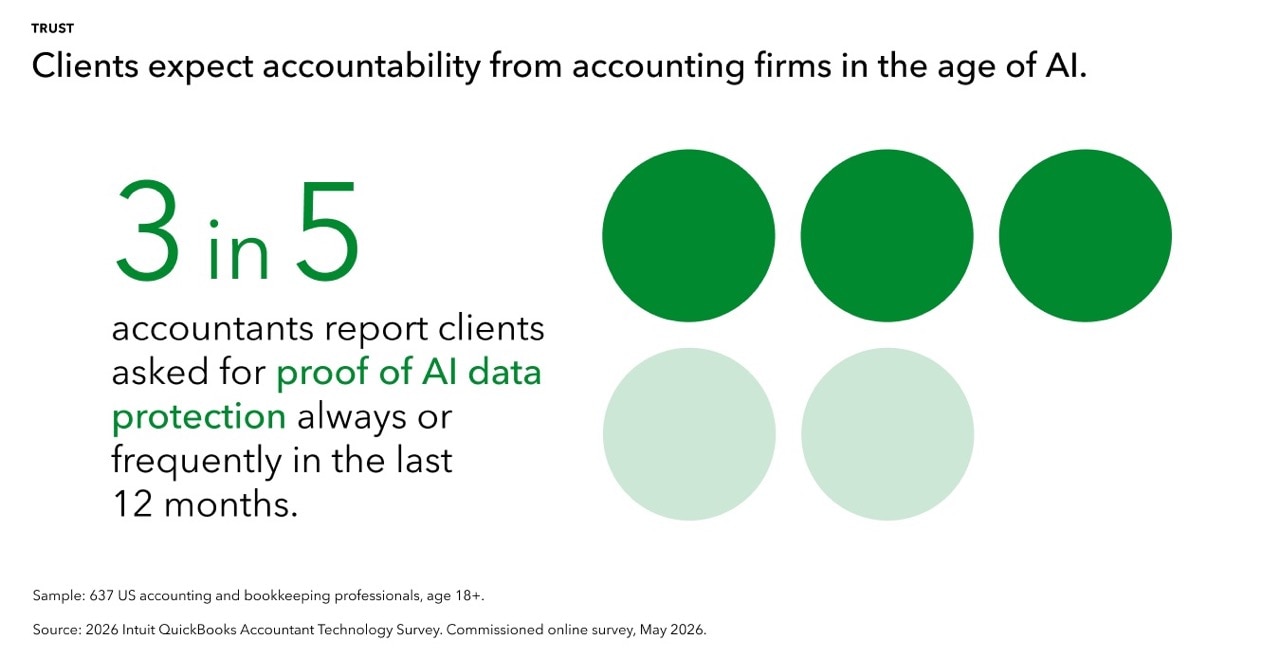
  • Trust questions are now part of the engagement: A third of respondents proactively explain how and when AI is used in client work. Nearly half address it when asked, and clients are asking: 60% say clients asked for proof of AI data protection always or frequently in the last 12 months.
  • Security is also becoming a competitive edge: 84% agree strong AI security practices help them keep current clients and win new ones.
  • Responsible AI is viewed as trust-building: 79% agree responsible AI can increase trust through consistency, earlier issue detection, and better documentation.
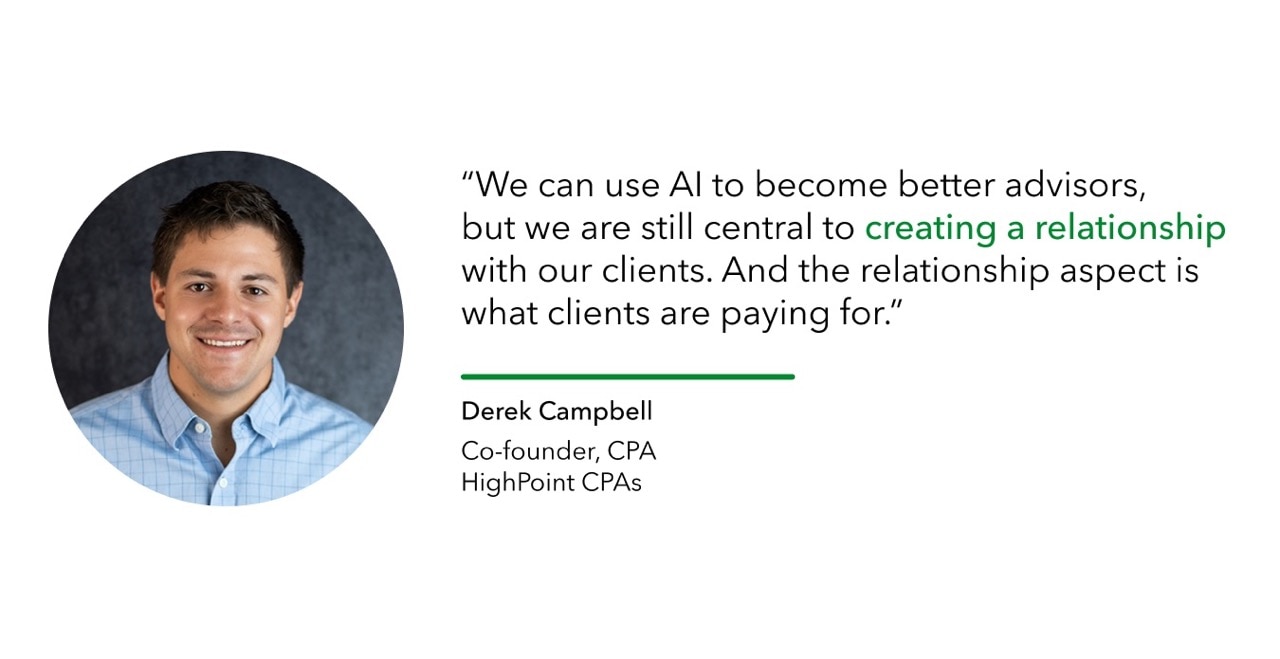
  • Accountability is why humans still matter: As AI takes on more routine work, 41% of respondents chose trust and oversight as the top reason clients will keep paying for human expertise, followed by complexity management (31%) and empathy (22%).
  • Two future firm identities, same trust requirement: 44% want to be known for growth-focused advisory by 2030, while 41% want to be known for best-in-class compliance and accuracy. Different models, same requirement: clients have to trust the work and the professional reviewing and approving it.
  • The winning formula combines AI efficiency with human expertise: 85% agree the firms that win the next decade will combine AI efficiency with human expertise and trust.
2026 Accountant Technology Survey

The talent squeeze. 

The pipeline is under pressure and the definition of a great hire is shifting fast.

Hiring remains difficult across experience levels, ramp time is long, and what firms are looking for in a candidate is changing. The emphasis is moving toward judgment, modern tools, and client-facing capability, not just technical proficiency.

What is happening to accounting hiring and talent in 2026?

  • Burnout is widespread, and data friction is part of the strain: 90% say fatigue and burnout have been a significant issue. Among those respondents, volume of work and billable pressure is the top driver (37%), followed by fragmented data (25%), showing how disconnected systems can add pressure to already-full workloads.
  • Hiring struggles are easing, but persist across every experience tier: 77% report at least one hiring struggle in the last 12 months (down from 80% in 2025 and 94% in 2024). The hardest tiers to fill are 1+ years (46%) and 5+ years (42%). Even at entry level, 1 in 3 say finding quality candidates has been difficult. But filling the role is only half the problem: 56% say a new entry-level hire would take 6+ months to become fully productive.
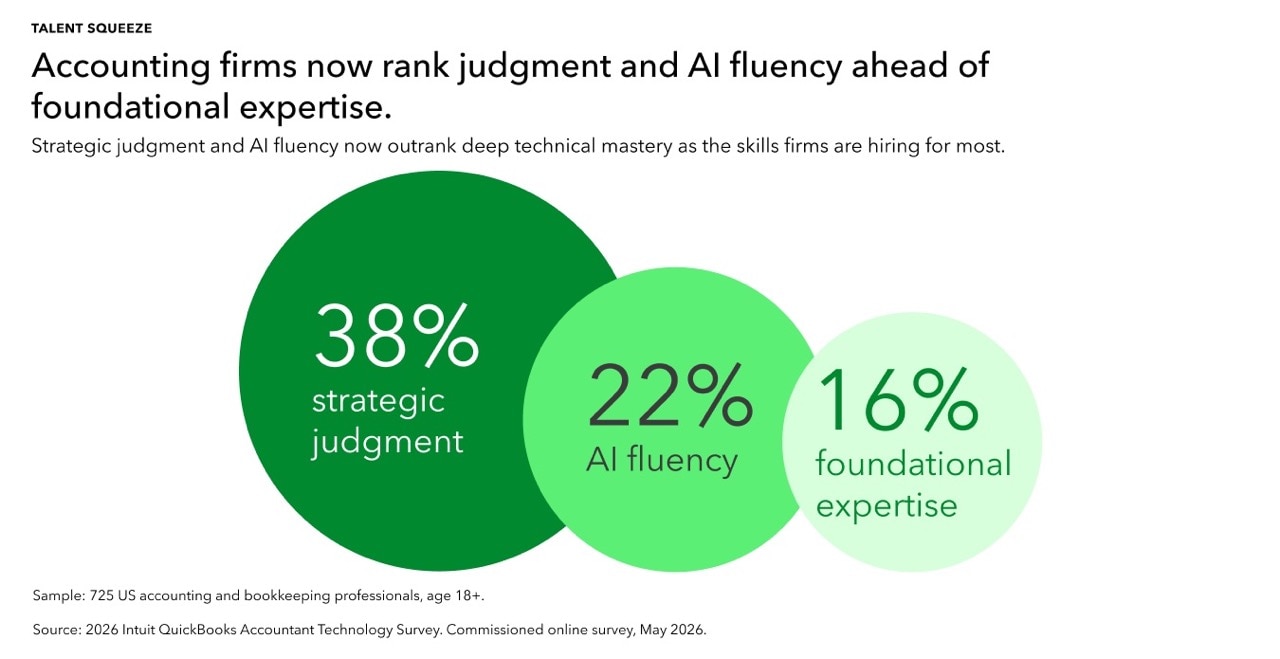
  • Firms are hiring for judgment first: 38% of respondents say strategic judgment is their firm’s top hiring priority, with AI fluency second (22%).
  • Tech skills are now a top hiring signal: Software and tech certifications (53%) and AI, automation, and data skills (53%) both rank ahead of the CPA credential or CPA track (50%) as the factors respondents say most improve an entry-level candidate's hiring chances.
  • Entry-level expectations are rising: Looking ahead, 35% expect entry-level hires to produce higher-level work sooner, and 31% expect the skills mix to shift toward tech, data, and client-facing work. In practice, juniors are already spending more time triaging exceptions and edge cases (35%) and getting pulled into client communication earlier (23%).
  • Accounting education has not caught up with what firms need: 1 in 4 respondents (26%) say accounting education is falling behind or failing to prepare graduates for AI-driven work. The top fix selected was stronger tech and data skills (33%).
2026 Accountant Technology Survey

The expanding mandate.

The job keeps getting bigger, even when capacity does not.

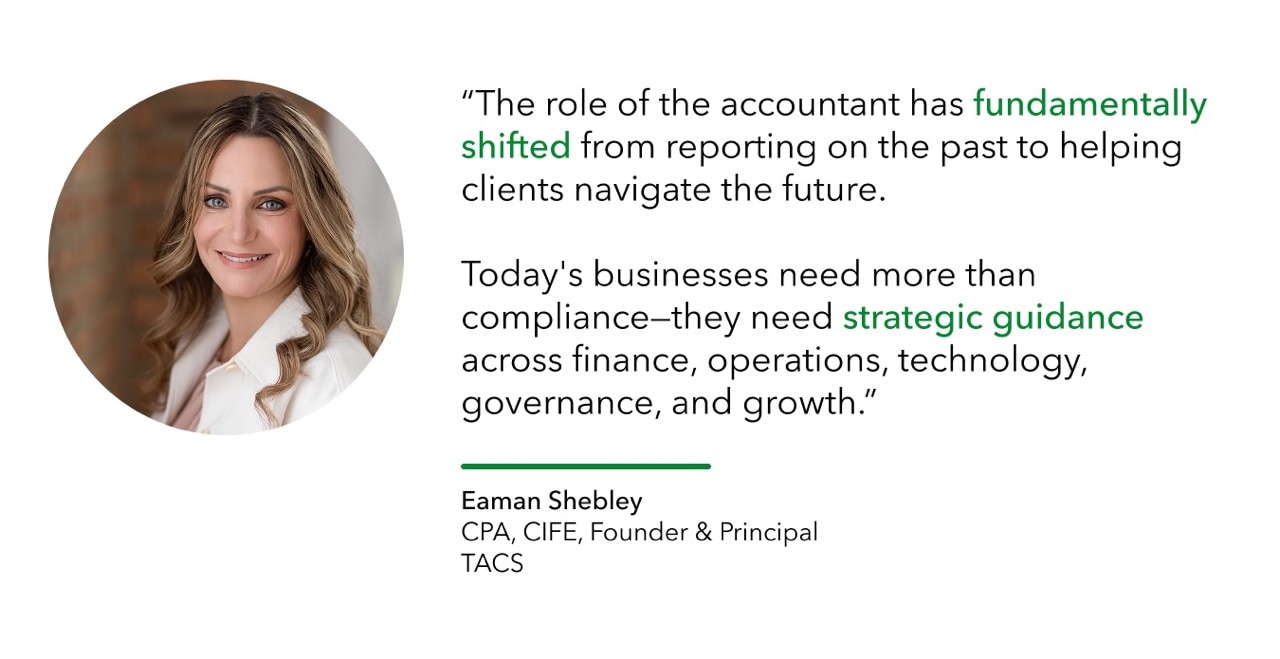
Client expectations are widening beyond traditional accounting, and outside friction is adding more work with no extra headcount. Many accountants are now part finance team, part tech guide, part HR support, and part regulatory liaison. The scope of the job changed without anyone formally updating the job description.

2026 Accountant Technology Survey

What new work is landing on accountants’ desks in 2026?

  • Client demand is rising across core finance work: More than half report clients needing more support in every financial category, led by financial management (61%), regulations and compliance (59%), and filing taxes (56%).
  • Non-finance asks are now routine: Clients are looking to accountants for more than traditional finance work, led by technology management (62%), business plans and strategy (59%), and general business advice (54%).
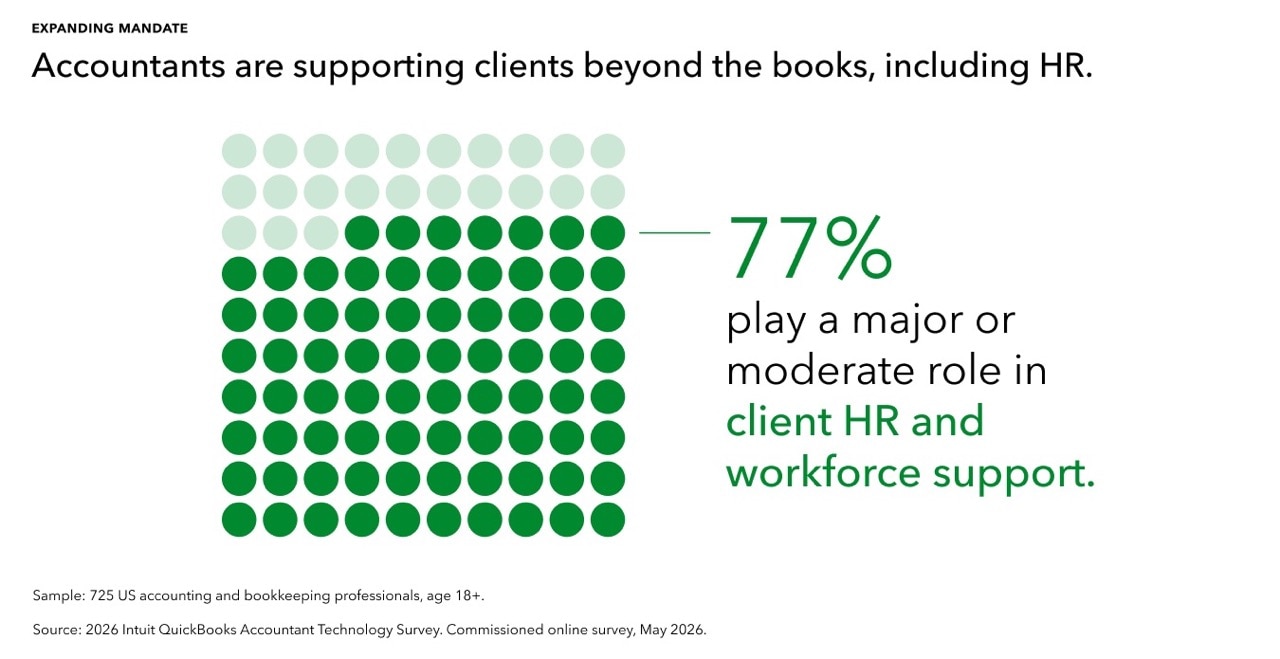
  • HR and workforce support has become core work: 77% play a major or moderate role in HR and workforce support for clients, including 34% who say it is a core and growing part of what they deliver.
  • Government friction is consuming real time: 70% say IRS staffing cuts have increased their administrative workload.
  • Official accounting standards are lagging behind AI reality for many practitioners: 23% say official standards are lagging or out of touch with how AI-driven work is being done in 2026.
2026 Accountant Technology Survey

What this means for accountants in 2026.

The data puts hard numbers behind what most firms already feel: time is leaking through disconnected tools, capacity is getting swallowed by cleanup, and the talent pipeline is not keeping up with demand. AI and outsourcing are helping, but only where firms have built them into repeatable workflows rather than reaching for them when it feels convenient.

The firms pulling ahead have done a few things consistently: cleared the operational drag, standardized how work moves through their tech stack, and made trust and accountability part of the client conversation before anyone asks. As a result, they are creating capacity for the work clients continue to pay a premium for: judgment, clarity, and high-stakes sign-off.

The bottlenecks are known. The solutions are visible in the data. The gap between firms that have acted on them and firms still navigating the seams is widening every year.

Methodology

Intuit commissioned an online survey in May 2026 of 725 accounting professionals throughout the US, all aged 18 and older. Forty-seven percent are aged 28–43, 30% are 44–59, and 13% are 18–27. Fifty-nine percent own an accounting or bookkeeping business and 41% are employed as accountants or bookkeepers within a firm. Among these participants, 25% work in larger firms with more than 100 employees, and 75% are part of firms that employ between 0 and 99 individuals.

56% of respondents are male and 42% are female. Percentages have been rounded to the nearest decimal place, so values shown in data report charts and graphics may not add up to 100%. Responses were collected using Prodege audience pools and partner networks with double opt-ins and random device engagement sampling. Respondents received remuneration.

Intuit Accountants helps accounting, bookkeeping and tax professionals save time and grow their practice. Follow us on LinkedIn, Instagram, and Facebook.


Recommended for you

Looking for something else?

Get QuickBooks

Smart features made for your business. We've got you covered.

Tax Pro Center

Expert advice and resources for today’s accounting professionals.

QuickBooks Support

Get help with QuickBooks. Find articles, video tutorials, and more.

How can we help?
Talk to sales 1-800-497-1712

Monday - Friday, 5 AM to 6 PM PT

Get product support