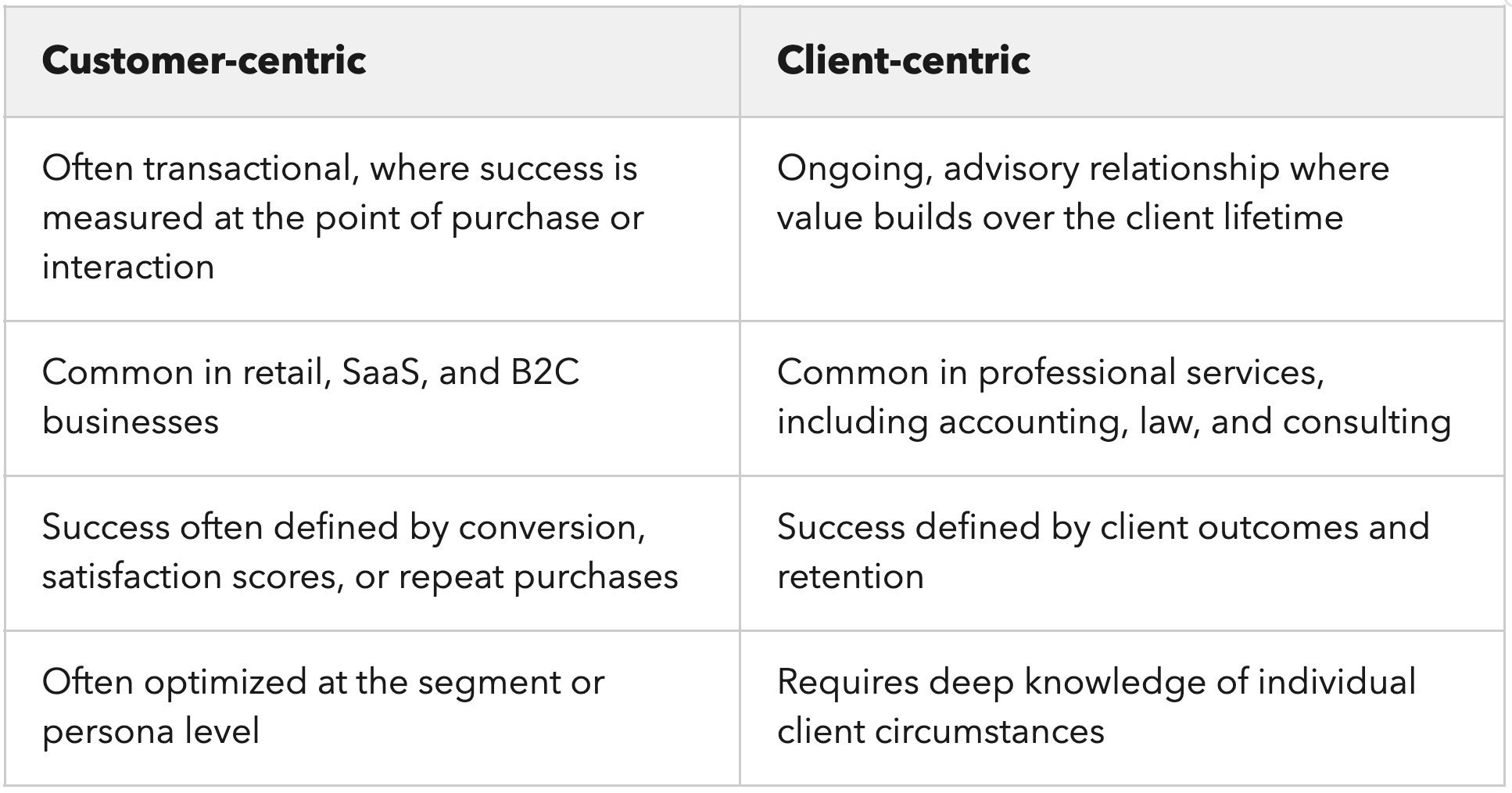
The underlying principles are the same, even if the mechanisms look different in a professional services context. A few sections down, we'll highlight a few customer-centric examples that illustrate what this looks like in practice, and what the equivalent move tends to be for an accounting firm.
Why a client-centric approach matters for your firm
The business case for client-centricity runs through four areas that affect firm economics:
- Retention: Clients who feel genuinely understood don't shop around. The barrier to switching firms isn't high for most businesses, and the incentive isn't either, when their current firm already knows their business deeply. Your knowledge of a client's goals, history, and pressure points is what makes the relationship difficult to replicate elsewhere. Client-centric firms build that depth deliberately, which is why they tend to see stronger retention.
- Referrals: Satisfied clients remain your most cost-effective growth channel. The accounting profession still runs largely on word-of-mouth. The most effective referrals, the ones where someone says, "You have to work with this firm" and not just "I can give you a name,” come from clients who feel the relationship has delivered real value. Research suggests that organizations with leading customer experience programs are 26x more likely to achieve annual revenue growth of 20% or more than organizations with weaker customer experience programs
- Advisory expansion: Firms that know their clients well are positioned to expand the scope of work naturally. When you understand a client's business model, their growth goals, and their pressure points, the conversation about adding a fractional CFO engagement, cash flow forecasting, or strategic planning support follows naturally from the relationship. And there’s clear demand for deeper advisory engagements. In one survey of small business owners, five out of six said they see their accountant as a trusted advisor they can turn to for a wide range of business advice, yet only 61% were satisfied with the breadth of services their accountant provides, suggesting both room and appetite for more strategic support.
- Differentiation: As AI continues to automate compliance work, the transactional parts of accounting such as tax prep, bookkeeping, and basic reporting, become increasingly commoditized. What isn’t commoditized is the judgment that comes from knowing a client's business well: understanding why their margins are compressing, anticipating how a hiring decision affects their cash position, or recognizing that a client who's been deferring equipment purchases is approaching a capital planning conversation they haven't thought to ask for yet. That kind of counsel is personal by nature, and it's what clients will pay a premium for when the underlying compliance work is table stakes.
These four areas reinforce each other most when a firm is built around clients who are genuinely the right fit for what it does well. A client-centric approach is what makes that fit visible in practice: it's what tells you which relationships are worth the retention effort, which referrals are worth pursuing, and which clients are ready for deeper advisory work. Over time, that visibility is what lets a firm keep building around the clients it serves best.
Client-centric examples: Firms that get it right
To see what client‑centric really looks like in an accounting context, it’s more useful to look at firms that have rebuilt their models around advisory than at consumer brands experimenting with social listening.
One example is Baker Tilly’s work with CPA.com to redesign the firm’s client advisory services practice using the CAS 2.0 framework. Instead of treating advisory as a collection of add‑on projects, Baker Tilly mapped services around client needs, formalized their business‑insights offering, and built a strategy to deliver ongoing guidance at scale.
Other firms have gone a step further by reshaping roles and workflows so client managers spend most of their time on higher‑value conversations. In one case study, a mid‑size UK‑based firm outsourced routine accounting tasks, redesigned review processes, and invested in training client managers on advisory skills so they could focus on planning, coaching, and decision support instead of chasing documents. The result was faster turnaround, stronger relationships, and more room for strategic work.
Taken together, these kinds of moves—being intentional about which clients you serve, building repeatable planning and forecasting processes, and using technology to surface real‑time insight—are what make advisory genuinely client‑centric. They turn “knowing your clients well” into concrete decisions about how you segment, staff, and deliver the work.
How to build a client-centric firm: A 7-step framework
Client-centricity is the result of several reinforcing practices working together — in how you set up new client relationships, how you use data, how you gather feedback, and how you measure what's working.
The seven steps below lay out a practical framework for building client-centricity into your firm, from establishing the right culture internally to measuring whether it's actually working.
1. Create a people-focused culture within your firm
Building a people-focused firm starts with those nearest to you, specifically your team. While data is a recurring theme in client-centricity, it's imperative to begin with a unified perspective of your clients and ensure it's adopted throughout your firm. In the end, your clients will choose a firm based on your people, not your data. Here are some ways to inspire a client focus in your firm:
2. Nail client onboarding and set expectations early
The first 30 to 60 days of a client relationship set the tone for everything that follows, and a structured onboarding process is one of the clearest places a client-centric firm distinguishes itself. Done well, it covers three areas:
- Surfacing the client's actual goals and concerns, not just the compliance deliverables that drove them to hire you.
- Establishing a written scope so both sides have clear expectations about who does what and when.
- Creating early, proactive touchpoints that signal to the client they're being actively managed.
Firms that invest in structured onboarding tend to see fewer mid-engagement surprises and faster document collection. At the same time, clients who understand the relationship from the start are more engaged partners in it.
3. Adopt a data-driven, holistic view of your clients
Mapping out your client's journey, beginning with the time before they contact you to your ongoing relationship, will help you discover opportunities for better understanding your clients. This comes from gathering meaningful data throughout their journey. You may already have collected a significant amount of data during meetings, calls, and emails. By scouring this data for recurring problems and challenges, you'll be able to increase your firm's offerings in ways that are meaningful instead of annoying. Since "data" can often seem like a vague buzzword, here are some examples of meaningful customer data:
- Contact information.
- Services offered to them.
- Referral.
- Frequency, duration, and topics of interactions with your staff.
- Communication preferences.
4. Avoid data silos within your firm
Once you've compiled customer data, however, correctly managing it is critical to its effective use. The "Power of Data Management" report by Vanson Bourne for Veritas found that lost or misplaced data results in an average 16% drop in employee productivity. Data will only lead to insightful action if it's not hoarded in various departments or people in your firm. As a firm leader, you can avoid data silos simply by storing customer data in a secure, centralized location like a customer relationship management (CRM) tool, and giving your staff appropriate access.
5. Always listen to your clients’ needs and wants
It can be easy to get caught up in what our clients need and avoid delving into their underlying wants, but you have a valuable opportunity to learn about their industry and individual business needs. By coming up with new ways to streamline their core operations or helping them stay on top of industry trends and news, you'll increase your perceived value and gain a client who is more than happy to refer their friends and colleagues to your firm.
Listening only creates value when it's systematic. The most client-centric firms don't rely on informal conversations to capture client sentiment and instead build it into regular practice. This could look like:
- Periodic client satisfaction surveys.
- A simple net promoter score (NPS) pulse at natural relationship milestones.
- Check-in meetings that happen on a set cadence.
The goal is to surface both points of friction and clear opportunities early, and a regular feedback cadence is what makes that possible consistently.
6. Use technology to scale a client-centric experience
A client-centric approach that depends entirely on individual relationships doesn't scale. As your firm grows, the practices that make a smaller firm feel personal need to be supported by systems, including AI that can surface what a single advisor would otherwise catch only by chance. The right technology stack helps in a few specific ways:
- A CRM or shared client view ensures that what one team member knows about a client is visible to others, so internal handoffs don't create gaps and clients always feel understood.
- Secure document exchange eliminates the email chains and follow-up requests that slow down onboarding and make routine information-gathering feel like a burden for both sides.
- Dashboards that surface key client metrics with, for example, cash flow trends, upcoming deadlines, and changes in business volume, give advisors the context they need to initiate conversations proactively.
- AI-powered insights on demand let advisors ask direct questions about a client's books or across their portfolio instead of digging through reports to find the answer, turning "let me look into that and get back to you" into an answer in the moment.
Intuit Accountant Suite is built to support exactly this kind of setup. It gives your team one sign-in for every client's financials and history, a dashboard tailored to what each team member needs to see that day, features that simplify client communication and streamlines document requests, and AI-powered client insights.
7. Measure and improve your client experience
Firms that take client experience seriously track two types of metrics consistently: relationship health indicators that tell you how clients feel about working with you, and business outcome metrics that tell you whether that's translating into firm growth. Some of the metrics that tell that story include:
- NPS or satisfaction scores: Surface how clients feel about the relationship at key moments.
- Client retention rate: The most direct indicator of whether clients feel well-served over time.
- Client lifetime value: Helps you understand which relationships are deepening and which are stagnating.
- Referral volume: A reliable signal that clients value the relationship enough to stake their own reputation on it.
The goal is to capture a full picture of how clients feel in the moment, whether that's holding over time, and whether the relationship is strong enough that they'd stake their reputation on recommending you. As you read the results together, you can also spot where something's off and adjust accordingly.
Building a client-centric firm is an ongoing practice
As a firm leader, there should be no higher priority than maintaining an authentic client focus throughout your firm. As client service is increasingly replaced with client experience, ensuring a premium experience is a must for every firm that wants to thrive in the coming years.
That pressure is only going to increase. As AI takes on more of the routine compliance work that has historically filled accounting firm capacity, the relationship becomes the product. Clients stay with firms that understand their business deeply and keep showing up with something useful. The firms that do that consistently are the ones building it into how they operate, and revisiting it as their clients' businesses evolve.
Building a client-centric firm is the result of deliberate, incremental decisions about how your team operates, how you use client data, and how you measure what's working. The framework above gives you a solid place to start. And once that foundation is in place, it becomes much easier to expand into the kind of advisory work that deepens client relationships further and drives firm growth.